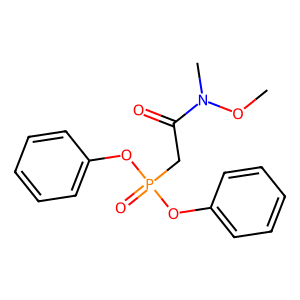
Diphenyl (2-(Methoxy(Methyl)Amino)-2-Oxoethyl)Phosphonate(CAS 367508-01-8)
| Purity | Grade | Package | Stock | Price | Quantity |
| 95% | RG | 100MG | In Stock | 15 USD
 |
|
| 95% | RG | 250MG | In Stock | 30 USD
|
|
| 95% | RG | 1G | In Stock | 88 USD
|
|
| 95% | RG | 5G | In Stock | 376 USD
|
|
| 95% | RG | 25G | In Stock | 1514 USD
|
|
| Bulk Packaging | 1KG | substantially lower unit cost than small-pack SKUs. Contact us for a fast quotation. | |||

|
|||||
 Your region is eligible for ordering.
 Available NMR Spectrum
Verified In Stock
Fast Shipping ISO 9001
Quality System
Applications of 367508-01-8
Multicomponent Synthesis of α-Aminophosphonate Bioisosteres
The Kabachnik–Fields reaction represents a powerful multicomponent methodology for the synthesis of α-aminophosphonate bioisosteres, which serve as structural analogues of naturally occurring α-amino acids . This three-component reaction involves the condensation of primary or secondary amines, carbonyl compounds such as aldehydes and ketones, and phosphorus-hydrogen containing species, particularly dialkyl phosphites, to generate α-aminophosphonates in a single synthetic operation .
The bioisosteric nature of α-aminophosphonates stems from their structural similarity to α-amino acids, where the carboxylate functionality is replaced by a phosphonate group . This replacement maintains similar spatial requirements while introducing unique electronic and metabolic properties that enhance biological activity and stability . The phosphonate moiety exhibits increased resistance to enzymatic degradation compared to carboxylate groups, making these compounds valuable as enzyme inhibitors and pharmaceutical agents .
Mechanistic investigations have revealed that the Kabachnik–Fields reaction predominantly proceeds through an imine intermediate pathway rather than an α-hydroxyphosphonate route . In situ Fourier transform infrared spectroscopy monitoring has demonstrated the formation of transient imine species, characterized by characteristic C=N stretching vibrations at approximately 1644-1648 cm⁻¹ . The reaction typically favors the imine mechanism due to the significantly lower energy gain associated with imine formation compared to α-hydroxyphosphonate intermediate formation .
The multicomponent nature of this reaction provides several synthetic advantages, including reduced waste generation compared to multi-step syntheses, operational simplicity, and the ability to introduce structural diversity through variation of the three components . Under optimized conditions, the reaction can be performed under solvent-free microwave irradiation, achieving excellent yields in remarkably short reaction times of 2-10 minutes .
Recent developments have expanded the substrate scope to include heterocyclic amines, cyclic phosphites, and various H-phosphinates, thereby broadening the structural diversity of accessible α-aminophosphonate bioisosteres . The incorporation of heterocyclic moieties has proven particularly valuable for accessing pharmaceutical targets, as these structural features often enhance biological activity and selectivity .
Asymmetric Catalysis for Enantioselective Aminophosphonate Production
Enantioselective synthesis of α-aminophosphonates has emerged as a critical area of research due to the profound influence of stereochemistry on biological activity . Asymmetric catalysis approaches have been developed to access optically pure α-aminophosphonates with high enantioselectivity, employing various chiral catalysts and auxiliaries .
BINOL-Derived Chiral Phosphoric Acids represent the most extensively studied class of catalysts for enantioselective hydrophosphonylation reactions . These binaphthyl-based catalysts bearing phosphoric acid functionalities at the 3,3'-positions have demonstrated remarkable efficiency in catalyzing the addition of dialkyl phosphites to preformed imines . The mechanism involves simultaneous activation of both the imine substrate and the phosphite nucleophile through a nine-membered cyclic transition state, where the phosphoric acid hydrogen activates the imine while the phosphoryl oxygen coordinates to the phosphite .
Optimization studies have revealed that the nature of the phosphite ester group significantly influences enantioselectivity, with diisopropyl phosphite consistently providing the highest levels of stereoinduction (up to 90% enantiomeric excess) . The trend in enantioselectivity generally follows the order: isopropyl > n-butyl > ethyl > n-propyl phosphites . This pattern suggests that increased steric bulk around the phosphorus center enhances the stereodifferentiation in the transition state.
H8-BINOL Catalysts have emerged as superior alternatives to fully aromatic BINOL derivatives for certain transformations . The partial reduction of the BINOL scaffold introduces increased flexibility and modified bite angles, enabling enhanced stereochemical control . These catalysts have demonstrated exceptional performance in the synthesis of quaternary α-aminophosphonates through Friedel-Crafts reactions of indoles with cyclic α-ketiminophosphonates, achieving enantioselectivities up to 95% .
Palladium-Catalyzed Asymmetric Hydrogenation of α-iminophosphonates has been developed as an alternative approach to chiral α-aminophosphonates . This methodology employs chiral phosphinooxazoline ligands to achieve highly enantioselective reduction of both linear and cyclic α-iminophosphonates, providing efficient access to optically active products with enantioselectivities reaching 99% .
Organocatalytic Approaches utilizing chiral Brønsted acids and bases have gained prominence for their operational simplicity and environmental benefits . Recent developments include the use of cinchona-derived thiourea catalysts for the addition of diphenyl phosphite to ketimines, achieving good to excellent enantioselectivities. Additionally, quinine-catalyzed enantioselective phospha-Michael additions have been employed for the synthesis of chiral β-aminophosphonates .
The stereochemical outcome in these catalytic systems is typically controlled by steric interactions between the catalyst framework and the substrate components. In BINOL-derived catalysts, the 3,3'-aryl substituents create a chiral pocket that enforces preferential facial approach of the nucleophile to the activated imine .
Hydrophosphonylation Transition State Analysis via DFT Calculations
Density Functional Theory calculations have provided crucial insights into the mechanistic details and stereochemical control in hydrophosphonylation reactions . These computational studies have elucidated the nature of transition states, reaction pathways, and the origins of enantioselectivity in catalyzed transformations .
Mechanistic Pathway Investigations using B3LYP/6-31G* and B3LYP/6-311G* levels of theory have confirmed the preference for the imine-mediated pathway over the α-hydroxyphosphonate route in Kabachnik–Fields reactions . Computational analysis reveals that imine formation proceeds with significantly lower energy gain (-18.6 kJ/mol) compared to α-hydroxyphosphonate formation (-40.5 kJ/mol), while the subsequent conversion of the hydroxyphosphonate to the final product represents only a marginal energy gain of 2.4 kJ/mol .
Transition State Geometries have been characterized through DFT calculations, revealing the involvement of nine-membered cyclic transition states in BINOL-phosphoric acid catalyzed reactions . These calculations predict that the stereochemistry is controlled by steric repulsion between the 3,3'-aryl groups of the catalyst and the bulky phosphite substrate . The computational models successfully reproduce the experimentally observed predominant formation of products with S configuration and high enantiomeric excess.
Aluminum-Catalyzed Hydrophosphonylation mechanisms have been investigated using DFT and ONIOM methods . The calculations demonstrate that the catalytically active species is an aluminum-phosphite complex formed via P-H activation mediated by the polarized Al^δ+^-Cl^δ-^ bond . The catalytic cycle comprises three elementary stages: coordination of the aldehyde, C-P bond formation via nucleophilic addition, and deprotonation leading to product formation with catalyst regeneration . The deprotonation step has been identified as rate-determining, with calculated activation barriers in the range of 20 kcal/mol .
Stereoselectivity Origins have been elucidated through computational analysis of chiral catalysts . In aluminum-salalen complexes, the calculations predict that both cis-α and cis-β configurations are accessible for intermediates and transition states, with the latter being more stable due to reduced distorted strain . The stereochemistry of the overall reaction is controlled by steric repulsion between the ortho tert-butyl groups of the ligand and the phosphite substrate .
Solvent Effects and Coordination have been incorporated into DFT models using continuum solvation methods . These studies reveal that the active species can form dimers containing solvent molecules under high concentration conditions, affecting reaction rates and selectivities . The calculations support experimental observations regarding concentration effects and the role of coordinating solvents in modulating catalytic activity.
Activation Barrier Analysis across different catalyst systems shows significant variation in calculated barriers . Molybdenum-catalyzed systems exhibit activation barriers of approximately 20 kcal/mol for C-P bond formation , while other metal catalysts show different energetic profiles depending on the coordination environment and electronic properties of the metal center.
Physical and chemical properties of 367508-01-8
Boiling Point |
453.1±37.0 °C at 760 mmHg |
|---|---|
Density |
1.3±0.1 g/cm3 |
Exact Mass |
351.087158 |
Flash Point |
227.8±26.5 °C |
Index of Refraction |
1.553 |
LogP |
2.71 |
Molecular Formula |
C16H18NO6P |
Molecular Weight |
351.291 |
PSA |
84.11000 |
Vapour Pressure |
0.0±1.1 mmHg at 25°C |
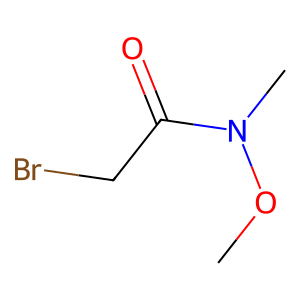 Cas:134833-83-3

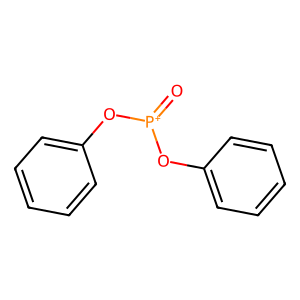 Cas:4712-55-4

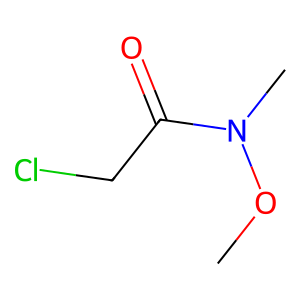 Cas:67442-07-3
Q&A for CAS 367508-01-8
1. How can I verify product quality?
Every batch of our Chemical Reagents is tested to meet ISO 9001 standards. We provide COA & NMR & SDS Provided with each shipment. Batch COA available for verification, and third-party retesting is supported. A full refund is offered if our data is incorrect.
2. What is the delivery time?
Orders from Ready stock / In stock items typically Ships Tomorrow via Fast Shipping via FedEx/DHL/UPS. International deliveries usually arrive within 7 business days, subject to customs clearance.
3. What if the received product doesn’t meet quality standards?
If your Lab Grade Chemical Reagents do not match the Batch COA available, we will issue a replacement or a full refund upon verification.
4. Are hazardous labels included? How is safe shipping ensured?
Hazardous products are labeled and packaged following international regulations. We provide SDS Provided with all hazardous shipments to ensure safe and compliant transport.
5. Do you offer technical support?
Yes. Our Lab Supplier team is available to assist with questions about product usage, storage, Lab Grade requirements, applications, and more.
6. Are volume discounts available?
Yes. For bulk orders of Chemical Reagents, we offer competitive pricing. Submit a quotation request and we’ll provide a tailored offer.
7. Do you provide samples?
Yes, samples are available for selected Lab Grade products. Please submit a request to confirm availability and specifications.
8. Do you have products in stock?
Yes. Items labeled In stock / Ready stock on our website are available for immediate shipment, usually within 1–2 business days. Large packs or custom specifications require lead time confirmation.
9. Can you customize purity or packaging?
Yes. We support customization of Lab Grade purity, packaging size, and special testing requirements. Share your needs and we’ll provide a tailored solution.
10. Is the COA consistent with the shipped batch?
Yes. Batch COA available matches the actual shipment. COAs shown online are for reference or from previous batches.
11. Do you support long-term supply agreements?
Yes. We offer Lab Supplier services for stable batch consistency, pricing agreements, and safety stock for long-term customers to ensure uninterrupted supply.
12. What payment methods do you accept?
We accept Pay Local Currency via bank transfer (T/T), PayPal, and other methods. Credit terms are available for qualified long-term partners.
Download COA of 367508-01-8
Operate under the ISO 9001 system